
In the main baboon troop (but probably not your average troop), there is a small cohort of elderly baboon female folk. It is not a distinct group, but more of a spectrum which merges into the rest of the troop's females.
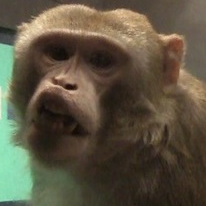
Gertrude and Midi spend much of their time in solitude. Gertrude in particular is usually found at one end of the troop or the other. Midi is harder to place, mostly because she is a very shy baboon, particularly around humans. And in my personal opinion, she's not much of a remarkable or interesting baboon to observe.
Gertrude is the most easily recognizable baboon in the troop. She is so old that she seems to have developed some type of bone pathology; she stands and walks with a permanent stoop. Her fur is ragged and her ears are torn, even more than usual. I think one might be almost entirely invisible, but the thing is, I never came to recognize her ears because she was so easily identifiable without them.
The connector between these two and the rest of the troop is Hilda, and without her, the group my be mistaken as actually being distinct. Then again, without Hilda, it would only be Gertrude and Midi exchanging groomings all day. The three of them form a triad, though Hilda is quite clearly the dominant of the three.
There is always an exception, however. Punzle's jaw is permanently fused out of place, and she's had so many children that her nipples and breasts can be seen as visibly uneven from possibly a hundred feet away. She is no spring guineafowl. Yet her only connection to the senior citizens of the troop is through Hilda, which indicates nothing, as Hilda is a highly ranked female, and as the beta female, she is deserving of attention from Punzle. I've never seen Punzle affiliate with either Gertrude or Midi.
Hilda is the true exception. She is a powerful memeber of the troop, probably the third ranked female. Why would she interact with the other old ladies?
When I think about the odd structure of the old lady demographic of the troop, I wonder at why some of the older females have maintained their ranks, and why some seem to have fallen off the chart. In a matrilinear system, these old females ought to have many female offspring surrounding them who would be locked into the a similar rank for life. Midi and Gertrude (in particular), appear to have almost no one.
The old ladies club doesn't seem to have any different relationship with the males. They seem to have very little relationship at all with the guys, of little surprise given the low fertility of these females (Gertrude has ceased to cycle at all). Yet, the only time I've ever seen a male herd Gertrude, it was Chester, and he made it into quite an affair. I'd never heard Gertrude make more than a couple grunts before then, and I've never again heard anything quite so desperate as Gertrude's screams.
Hilda and Gertrude are a particularly odd comparison, since I believe the two to be related. I might be totally off, but those faces are just a bit too similar for me to write off. They couldn't have the same mother, though. Then rank would follow inheritance, and they would not appear so far distant in the heirarchy. I tell you what, though. This post is nearing the length I'd like to keep it at, so I'm going to bow out of this example and give it a of its own, in a few days. It deserves it.
Regardless, Hilda does interact with the other old ladies, so maybe Gertrude and Midi were once of higher rank (I have seen female baboons fall and be ruined, in the dramatic Aristocratic sense). Or perhaps Hilda is just a magnanimous kind of baboon. Come to think of it, I just like Hilda. She isn't a shameless flirt like the young Siri, nor a raging bitch like Punzle, nor terrifying like Lottie. She might not be the best looking lady baboon out there, but she seems like a pretty decent monkey being.
Friday, February 25


Wednesday, February 16
The Southern Siamang Drawl
Crested Gibbons Sing in Different Dialects
Crested gibbons of the genus Nomascus are small apes that live in the dense rainforests of Cambodia, China, Laos and Vietnam. All seven species communicate by singing—they sing to define their territory and find a mate, and male-female pairs sing duets to strengthen their bond, rather like a Bollywood couple.
Read more...
Have any of these journalists seen a Bollywood movie?
Since I study the origins of communication, language, and not-language, this paper was hard for me to ignore. And the study subjects are gibbons! Gibbons generally are largely ignored for being boring and not-as-smart as great apes. Also, they live in the secluded treetops of Southeast Asian, and are exceedingly rare. Near Extinct kind of rare, in several cases, so its great that they're getting some publicity.
Plus, this is legitimately interesting! Its kind of like that songbird song variation, except more clustering than I've seen in birds and gibbons actually have similar brains as we do, so the research is not as totally ridiculous. Shocking!
Archaeolinguists and population geneticists have tried to connect biological evolution with the evolution of languages, and they haven't exactly failed. There are connections, or at very least correlations, in human, so finding this in gibbons is quite exciting. I hope someone looks into this in other ape species.
Link for the paper, if you so desire.
Crested gibbons of the genus Nomascus are small apes that live in the dense rainforests of Cambodia, China, Laos and Vietnam. All seven species communicate by singing—they sing to define their territory and find a mate, and male-female pairs sing duets to strengthen their bond, rather like a Bollywood couple.
Read more...
Have any of these journalists seen a Bollywood movie?
Since I study the origins of communication, language, and not-language, this paper was hard for me to ignore. And the study subjects are gibbons! Gibbons generally are largely ignored for being boring and not-as-smart as great apes. Also, they live in the secluded treetops of Southeast Asian, and are exceedingly rare. Near Extinct kind of rare, in several cases, so its great that they're getting some publicity.
Plus, this is legitimately interesting! Its kind of like that songbird song variation, except more clustering than I've seen in birds and gibbons actually have similar brains as we do, so the research is not as totally ridiculous. Shocking!
Archaeolinguists and population geneticists have tried to connect biological evolution with the evolution of languages, and they haven't exactly failed. There are connections, or at very least correlations, in human, so finding this in gibbons is quite exciting. I hope someone looks into this in other ape species.
Link for the paper, if you so desire.
Wednesday, February 9
Instantaneous Evolution
Gorilla strolls on hind legs
Behavior might give him 'height advantage to look over the wall' at feeding time. A gorilla at a British animal park has achieved fame for walking upright on his hind legs like a human.
Read more...
Try not to get tired of that GIF. I know I won't.
I don't have all that much to say about this discovery. Its a single gorilla who developed this talent in adulthood. There's no epigenetics madness going on here.
I think the most interesting (read: cold and unfeeling) thing we serve to learn from this dude is how his skeleton is shaped. Can he pull this off with a standard gorilla skeleton? Or are their subtle differences in his physical form which could shed light on which were the first developments in early hominid precursors (Ardipithecus and friends) which lead to bipedal locomotion.
Also this dude weighs almost 500 pounds, so these leisurely strolls are super awesome.
Edit: Pic link has been TRANSFORMED into a youtube video with more footage and interviews and all kinds of shit. Also, the original GIF was of a different gorilla...
Friday, February 4
Dream Paper
A few months back, a paper which excited me to no end. It was the kind of work I fervently wished I could do, and in all honestly, there's not too much I would have given to be the first author of that paper.
However, I this was evidently not to be. Still, I had hoped to give me the original paper a respectful nod here for being totally amazing. Even this, I was unable to accomplish, as my workload exploded.
Now, I have a chance to save face, since the author, esteemed primatologist Kevin Langergraber of the Max Plank Institute EVA and Boston University, has released another paper which might be even finer than the first.
Perspective first: the original paper was a big collaboration featuring Boesch, Mitani, Wrangham, Vigilant, a bunch of the Japanese crew, and others. Not quite the 1999 paper by Andy Whiten and just about anyone who ever studied wild chimpanzees. The second paper is a bit smaller in depth, but for me, quite a bit more interesting.
I see now that in my excitement, I've not given more than the barest inkling of an explanation of just what type of research this is. Well, the first was titled Genetic and 'cultural' similarity in wild chimpanzees. Title says quite a bit, but it doesn't give the reader an instant understanding of how similar these two measures are where the similarity might lie.
Langergraber et al. basically take Whiten's premises that chimp populations have distinct behaviors, some of which are shared between groups, and some of which are unique, and attempts to correlate them with genetic data from these same chimp populations. Authors' report: correlation is strong.
More specifically, levels of overall behavioral dissimilarity was highly correlated with overall genetic dissimilarity. Meaning, few behavior varied between groups who were genetically similar, whereas groups between which much genetic distance exists shared fewer behaviors.
The authors stress that reader should not be drawn in by the correlation fallacy. These data reveal that genetics could very easily be playing a role, but that does not mean they are. Cultural effects may be in play, which are unfortunately notoriously difficult to measure in our species, much less chimpanzees.
So what's new? What do Kevin Langergraber and company have for us this time?
Genetic differentiation and the evolution of cooperation in chimpanzees and humans
Langergraber K, Schunert G, Rowney C, Wrangham R, Zommers Z, Vigilant L (2011) Genetic differentiation and the evolution of cooperation in chimpanzees and humans. Procedings of the Royal Society Series B doi: 10.1098/rspb.2010.2592
Abstract
It has been proposed that human cooperation is unique among animals for its scale and complexity, its altruistic nature and its occurrence among large groups of individuals that are not closely related or are even strangers. One potential solution to this puzzle is that the unique aspects of human cooperation evolved as a result of high levels of lethal competition (i.e. warfare) between genetically differentiated groups. Although between-group migration would seem to make this scenario unlikely, the plausibility of the between-group competition model has recently been supported by analyses using estimates of genetic differentiation derived from contemporary human groups hypothesized to be representative of those that existed during the time period when human cooperation evolved. Here, we examine levels of between-group genetic differentiation in a large sample of contemporary human groups selected to overcome some of the problems with earlier estimates, and compare them with those of chimpanzees. We find that our estimates of between-group genetic differentiation in contemporary humans are lower than those used in previous tests, and not higher than those of chimpanzees. Because levels of between-group competition in contemporary humans and chimpanzees are also similar, these findings suggest that the identification of other factors that differ between chimpanzees and humans may be needed to provide a compelling explanation of why humans, but not chimpanzees, display the unique features of human cooperation.
The paper combines three of my favorite subject in science, perhaps even the world: behavioral genetics, altruism, and chimpanzees. This is a great premise: compare the genetics of our closest ancestors with comparative human populations. The authors chose to look at modern populations, and not just hunter-gatherers, but also pastoral/agricultural populations. They examined different types of Africans, Aborigines, Pacific Islanders, and American Indians, to see if any connections exists between group genetics, competitive behavior, and altruism.
The work smacks of Mitani's research, in many ways, since it relies on his detailed research into the brutal, territorial male chimp. However, the authors take a more serious look at the other side of aggressive behavior as well, plus, spend much of the paper comparing to humans to test the hypotheses of Samuel Bowles.
Ultimately, between-group genetic differences in humans were not found to be greater than the between-group differences in chimps. Hooray, negative data! Since these genetic differences are approximately the same between species, the authors suggest that these particular genetics are not responsible for human altruism.
I do take some issues with this paper, compromising their main message for me.
I don't agree with the author's selection of groups representative of humankind at the time when modern levels of cooperation first developed. I commend them for looking at populations outside of contemporary hunter-gatherer, and going out of their way to find minimally admixed population that have displayed significant cultural development. But its still too tenuous an assertion, though the crux of my reasoning is way too elaborate to stick into this already monster post, so I'll need to return to it later.
Nevertheless, this is a great starting point, and the paper was a spectacular read. It definitely elucidated a numbering lingering question about Bowles' theories. I sincerely hope that this is not the last of such papers we see from Langergraber, and that others will pursue similar lines of research in order to enrich the field.
However, I this was evidently not to be. Still, I had hoped to give me the original paper a respectful nod here for being totally amazing. Even this, I was unable to accomplish, as my workload exploded.
Now, I have a chance to save face, since the author, esteemed primatologist Kevin Langergraber of the Max Plank Institute EVA and Boston University, has released another paper which might be even finer than the first.
Perspective first: the original paper was a big collaboration featuring Boesch, Mitani, Wrangham, Vigilant, a bunch of the Japanese crew, and others. Not quite the 1999 paper by Andy Whiten and just about anyone who ever studied wild chimpanzees. The second paper is a bit smaller in depth, but for me, quite a bit more interesting.
I see now that in my excitement, I've not given more than the barest inkling of an explanation of just what type of research this is. Well, the first was titled Genetic and 'cultural' similarity in wild chimpanzees. Title says quite a bit, but it doesn't give the reader an instant understanding of how similar these two measures are where the similarity might lie.
Langergraber et al. basically take Whiten's premises that chimp populations have distinct behaviors, some of which are shared between groups, and some of which are unique, and attempts to correlate them with genetic data from these same chimp populations. Authors' report: correlation is strong.
More specifically, levels of overall behavioral dissimilarity was highly correlated with overall genetic dissimilarity. Meaning, few behavior varied between groups who were genetically similar, whereas groups between which much genetic distance exists shared fewer behaviors.
The authors stress that reader should not be drawn in by the correlation fallacy. These data reveal that genetics could very easily be playing a role, but that does not mean they are. Cultural effects may be in play, which are unfortunately notoriously difficult to measure in our species, much less chimpanzees.
So what's new? What do Kevin Langergraber and company have for us this time?
Genetic differentiation and the evolution of cooperation in chimpanzees and humans
Langergraber K, Schunert G, Rowney C, Wrangham R, Zommers Z, Vigilant L (2011) Genetic differentiation and the evolution of cooperation in chimpanzees and humans. Procedings of the Royal Society Series B doi: 10.1098/rspb.2010.2592
Abstract
It has been proposed that human cooperation is unique among animals for its scale and complexity, its altruistic nature and its occurrence among large groups of individuals that are not closely related or are even strangers. One potential solution to this puzzle is that the unique aspects of human cooperation evolved as a result of high levels of lethal competition (i.e. warfare) between genetically differentiated groups. Although between-group migration would seem to make this scenario unlikely, the plausibility of the between-group competition model has recently been supported by analyses using estimates of genetic differentiation derived from contemporary human groups hypothesized to be representative of those that existed during the time period when human cooperation evolved. Here, we examine levels of between-group genetic differentiation in a large sample of contemporary human groups selected to overcome some of the problems with earlier estimates, and compare them with those of chimpanzees. We find that our estimates of between-group genetic differentiation in contemporary humans are lower than those used in previous tests, and not higher than those of chimpanzees. Because levels of between-group competition in contemporary humans and chimpanzees are also similar, these findings suggest that the identification of other factors that differ between chimpanzees and humans may be needed to provide a compelling explanation of why humans, but not chimpanzees, display the unique features of human cooperation.
The paper combines three of my favorite subject in science, perhaps even the world: behavioral genetics, altruism, and chimpanzees. This is a great premise: compare the genetics of our closest ancestors with comparative human populations. The authors chose to look at modern populations, and not just hunter-gatherers, but also pastoral/agricultural populations. They examined different types of Africans, Aborigines, Pacific Islanders, and American Indians, to see if any connections exists between group genetics, competitive behavior, and altruism.
The work smacks of Mitani's research, in many ways, since it relies on his detailed research into the brutal, territorial male chimp. However, the authors take a more serious look at the other side of aggressive behavior as well, plus, spend much of the paper comparing to humans to test the hypotheses of Samuel Bowles.
Ultimately, between-group genetic differences in humans were not found to be greater than the between-group differences in chimps. Hooray, negative data! Since these genetic differences are approximately the same between species, the authors suggest that these particular genetics are not responsible for human altruism.
I do take some issues with this paper, compromising their main message for me.
I don't agree with the author's selection of groups representative of humankind at the time when modern levels of cooperation first developed. I commend them for looking at populations outside of contemporary hunter-gatherer, and going out of their way to find minimally admixed population that have displayed significant cultural development. But its still too tenuous an assertion, though the crux of my reasoning is way too elaborate to stick into this already monster post, so I'll need to return to it later.
Nevertheless, this is a great starting point, and the paper was a spectacular read. It definitely elucidated a numbering lingering question about Bowles' theories. I sincerely hope that this is not the last of such papers we see from Langergraber, and that others will pursue similar lines of research in order to enrich the field.
Wednesday, February 2
Is the monkey touching the man, or the man touching the monkey?
Don't tell anyone, but I've been trying to stick to a Wednesday posting schedule lately. I'm midway through a full post, but I've been writing an awful lot of important stuff lately, and Firefox is making it a bloody difficult job to finish this one.
Here's another sweet youtube video to excuse my need for an extension till tomorrow.
Don't mess with the macaques. I've got footage of squirrel monkeys crawling all over me, but they're no where near that size, and there weren't even anywhere close as many, either.
Here's another sweet youtube video to excuse my need for an extension till tomorrow.
Don't mess with the macaques. I've got footage of squirrel monkeys crawling all over me, but they're no where near that size, and there weren't even anywhere close as many, either.
Wednesday, January 26
Strange Days
So this is on the internet now.
Thanks again, Japan. I have been watching this video several times a day, and after such exposure, I could not help but begin to think (also thanks to the prodding of others) how this combination of behaviors could come to pass.
At its core, this is a straight-forward example of imprinting. It helps to look at the original video source, which is here. If the comments are to be believed (and I know I am asking a lot for anyone, anywhere, ever, to believe youtube comments), then the pig and monkey were without mothers, and imprinted on each other. Part of this is very reasonable, and quite obvious. The monkey is clearly treating the pig like its mother. I'm not sure about the pig, as I am not much of an armchair swine ethologist.
There are a few oddities about this video, which I intend to discuss. The story probably is not so clear as "akeminxx" would lead us to believe.
Returning to the pig for a moment, I don't know how I feel saying that the pig is imprinted with the baby as its mother. I also don't even know how old the pig is. Imprinting on adults is astronomically difficult in most animals, though. A telling moment in the video comes when the monkey falls off, and the pig bolts. From this, I would guess that the pig and the monkey were put together at some prior date, and the monkey imprinted on the pig. The pig is effectively domesticated, and when placed in such close quarters with the monkey at all hours, there really wasn't much to do but submit. Pigs are smart creatures, too.
And how about that monkey? Like I said, the monkey is clearly treating the pig like as mother. I'm not experienced enough to identify the species from the infant's appearance alone, but if I had to make an educated guess, I'd say this is a Japanese Macaque, seeing as they are popular critters... and this is in Japan.
These monkeys (as do baboons) ride their mothers on the belly, usually, but as they grow older, they will often ride on-top, in a very similar hold as they would on the belly. But they cling to their mother, and generally their mother only. I do not think a screaming fit like that put on display by this baby monkey would ensue unless the animal was separated from its "mother." So there you go: pig-mama it is.
The backwards part is very strange, though. In the baboons, one would occasionally see very young infants climb aboard their mother's bellies backwards, but this behavior was quickly rectified by the mother before she started to carry the baby anywhere. I've not yet thought of a good reason for why this baby monkey would ride backward. It might be that the animal began riding backward by chance, or some small reason, and since the pig was unable to adjust this behavior like a monkey mother, the backwards behavior stuck. Maybe there's even a semi-legitimate reason for the monkey to hold on backwards, perhaps the position affords a better hold on the pig's flanks. I would think that at this age, the monkey would much prefer to look forward than get a slightly better handhold on some tufts of pig hair, but hey, imprinting is a powerful and strange thing. There are just too many thing I don't know and cannot infer from watching two minutes of youtube.
Thanks again, Japan. I have been watching this video several times a day, and after such exposure, I could not help but begin to think (also thanks to the prodding of others) how this combination of behaviors could come to pass.
At its core, this is a straight-forward example of imprinting. It helps to look at the original video source, which is here. If the comments are to be believed (and I know I am asking a lot for anyone, anywhere, ever, to believe youtube comments), then the pig and monkey were without mothers, and imprinted on each other. Part of this is very reasonable, and quite obvious. The monkey is clearly treating the pig like its mother. I'm not sure about the pig, as I am not much of an armchair swine ethologist.
There are a few oddities about this video, which I intend to discuss. The story probably is not so clear as "akeminxx" would lead us to believe.
Returning to the pig for a moment, I don't know how I feel saying that the pig is imprinted with the baby as its mother. I also don't even know how old the pig is. Imprinting on adults is astronomically difficult in most animals, though. A telling moment in the video comes when the monkey falls off, and the pig bolts. From this, I would guess that the pig and the monkey were put together at some prior date, and the monkey imprinted on the pig. The pig is effectively domesticated, and when placed in such close quarters with the monkey at all hours, there really wasn't much to do but submit. Pigs are smart creatures, too.
And how about that monkey? Like I said, the monkey is clearly treating the pig like as mother. I'm not experienced enough to identify the species from the infant's appearance alone, but if I had to make an educated guess, I'd say this is a Japanese Macaque, seeing as they are popular critters... and this is in Japan.
These monkeys (as do baboons) ride their mothers on the belly, usually, but as they grow older, they will often ride on-top, in a very similar hold as they would on the belly. But they cling to their mother, and generally their mother only. I do not think a screaming fit like that put on display by this baby monkey would ensue unless the animal was separated from its "mother." So there you go: pig-mama it is.
The backwards part is very strange, though. In the baboons, one would occasionally see very young infants climb aboard their mother's bellies backwards, but this behavior was quickly rectified by the mother before she started to carry the baby anywhere. I've not yet thought of a good reason for why this baby monkey would ride backward. It might be that the animal began riding backward by chance, or some small reason, and since the pig was unable to adjust this behavior like a monkey mother, the backwards behavior stuck. Maybe there's even a semi-legitimate reason for the monkey to hold on backwards, perhaps the position affords a better hold on the pig's flanks. I would think that at this age, the monkey would much prefer to look forward than get a slightly better handhold on some tufts of pig hair, but hey, imprinting is a powerful and strange thing. There are just too many thing I don't know and cannot infer from watching two minutes of youtube.
Wednesday, January 5
The Old Man and the Vine Tree
Those wild chimps have been using twigs as dolls for... ever, in all likelihood. Those data were collected over the course of almost two decades, but here's something which is a new(ish) development in Chimp "tool" use, and potentially asks some intriguing questions about the origins of culture.
Cultured Chimps Invent and Share Back-Scratching Tool
"I would sometimes spend days trying to find the chimps and then they might travel through everything from muddy swamps and thick undergrowth to colonies of army ants before there'd be a good chance to film them," said researcher Catherine Hobaiter, a primatologist at the University of St. Andrews in Scotland. "But then, when you do get to observe them in their natural habitat, it's an incredibly rewarding experience, and you completely forget about the fact you're sitting in the mud with ants in your socks!"
One chimpanzee there was named Tinka, a roughly 50-year-old male who had near-total paralysis in both hands. Until recently, Sonso chimpanzees would encounter large numbers of snares intended for bush pigs and kinds of antelopes known as duiker, leading one-in-three adult chimps in the community to have permanent disabilities.
To compensate for his paralysis, Tinka invented a new way to groom himself using a liana, or woody vine. Imagine using a towel on your back, except in this case, rather than moving the towel, Tinka held the liana taut with his feet and moved his body against it.
Yeah, so the article is from August. I've had a bit of a backlog. I'll link to directly to the video, though. You ought to watch it so you can see how unimpressive the actual behavior appears to be. That's not really the point though - its about the fact that this old paralyzed dude invented the behavior from scratch (oh I'm so clever), and then the chimps in community picked up a completely novel behavior by copying the actions of another.
How cultural elements are transferred and absorbed is kind of a big deal (at least to me), since we know so little about it, and in humans, we don't have many effective ways to design ethologically sound experiments. Plus, creating proper controls is a bitch. The chimps in this study were entirely wild, however, and though this study was purely observational, if chimps are capable of cultural transmission, it might open up new avenues for experimentation along these lines.
Cultured Chimps Invent and Share Back-Scratching Tool
"I would sometimes spend days trying to find the chimps and then they might travel through everything from muddy swamps and thick undergrowth to colonies of army ants before there'd be a good chance to film them," said researcher Catherine Hobaiter, a primatologist at the University of St. Andrews in Scotland. "But then, when you do get to observe them in their natural habitat, it's an incredibly rewarding experience, and you completely forget about the fact you're sitting in the mud with ants in your socks!"
One chimpanzee there was named Tinka, a roughly 50-year-old male who had near-total paralysis in both hands. Until recently, Sonso chimpanzees would encounter large numbers of snares intended for bush pigs and kinds of antelopes known as duiker, leading one-in-three adult chimps in the community to have permanent disabilities.
To compensate for his paralysis, Tinka invented a new way to groom himself using a liana, or woody vine. Imagine using a towel on your back, except in this case, rather than moving the towel, Tinka held the liana taut with his feet and moved his body against it.
Yeah, so the article is from August. I've had a bit of a backlog. I'll link to directly to the video, though. You ought to watch it so you can see how unimpressive the actual behavior appears to be. That's not really the point though - its about the fact that this old paralyzed dude invented the behavior from scratch (oh I'm so clever), and then the chimps in community picked up a completely novel behavior by copying the actions of another.
How cultural elements are transferred and absorbed is kind of a big deal (at least to me), since we know so little about it, and in humans, we don't have many effective ways to design ethologically sound experiments. Plus, creating proper controls is a bitch. The chimps in this study were entirely wild, however, and though this study was purely observational, if chimps are capable of cultural transmission, it might open up new avenues for experimentation along these lines.
Wednesday, December 29
Chimps Use Dolls?
Young female chimpanzees treat sticks as dolls: Growing evidence of biological basis for gender-specific play in humans##
ScienceDaily (2010-12-22) -- Researchers have reported some of the first evidence that chimpanzee youngsters in the wild may tend to play differently depending on their sex, just as human children around the world do. Scientists say female chimpanzees appear to treat sticks as dolls, carrying them around until they have offspring of their own. Young males engage in such behavior much less frequently. ... > read full article
This article elicited a "huh?" reaction from me when I first saw it. However, the results are derived from 14 years of aggregate data, is being supervised by Richard Wrangham, which means I am inclined to believe it. It would not be entirely preposterous for them to need so much observation time in order for them to be able to pick out a significant number of instances of a very particular behavior such as this.
Wired has their take on the story as well (wait, since when does Wired cover primatology?), which is also worth skimming over for the images at very least.
ScienceDaily (2010-12-22) -- Researchers have reported some of the first evidence that chimpanzee youngsters in the wild may tend to play differently depending on their sex, just as human children around the world do. Scientists say female chimpanzees appear to treat sticks as dolls, carrying them around until they have offspring of their own. Young males engage in such behavior much less frequently. ... > read full article
This article elicited a "huh?" reaction from me when I first saw it. However, the results are derived from 14 years of aggregate data, is being supervised by Richard Wrangham, which means I am inclined to believe it. It would not be entirely preposterous for them to need so much observation time in order for them to be able to pick out a significant number of instances of a very particular behavior such as this.
Wired has their take on the story as well (wait, since when does Wired cover primatology?), which is also worth skimming over for the images at very least.
Saturday, December 25
The Entity Known as Tim Curry
That's a bit of an place to pickup again after long delay, isn't it? You see, I'd been spending a bit more time with Tim Curry's group (TC), and as time wore on, it became almost half the time that I was with them, one way or another. They're a bizarre little group, but let me introduce a few of the key players.
Yes, other than Mr. Curry, whose name defies the measurement of time, all of the adult baboons are given Greek names which have Herodotus' Inquiries in common. But I'm sure we all knew that, so let's just keep moving. You'll hear of the other members of the troop a few posts down the line.
The history of this group is shrouded in mystery and shadows. Before I spent any significant measure of time with these misfits, there was an ancient female among them, far older than Terpsichore. She vanished one day, according to our colleague who regularly visited TC, and was never seen again. As an aged female, her permanent disappearance was marked down to natural causes.
When I began appearing regularly on the scene, Xerxes had just joined the little troop, and had yet to be accepted by the rest of the group. Honestly, he's yet to reach a level of full acceptance on my watch. Maybe the guy really was too much of an asshole to everyone else for his own good. Cyrus had been with the group some time, probably as alpha for most of that, thus the infants and juveniles were likely almost all his. He could afford to get most of the females with so few to worry about.
Terpsichore and Tim seemed to have a thing going on, so that the two of them would consort whenever she swelled in estrous. Tim probably kept control of the deceased old lady who I never met, too. Tim might have occasionally copulated with the lower ranked females. That left 2 or 3 for Tim, and 4 or 5 for Cyrus. Respectable numbers, until Xerxes appeared on the scene.
Since then, everything has been in flux. Cyrus' dominance has been eroding, and looks like it will continue to erode, and the consortship assortments between males and female more and more appear to be completely out the window.
Tim's role in the new male triumvirate was unclear to me. Many civilians said that the troop would go nowhere without him, in spite of his comparatively low position in the male hierarchy. They were mistaken, or at least they were some of the time.
One time in particular, Timmy found his way up into a tree while foraging, as if he were reliving his juvenile years. He apparently found some tasty stuff to munch (the other working theory, which would explain much of Tim's behavior, is that he is no longer quite right in the head), since he remained up there for almost half an hour. This gave the rest of the troop time to move out of sight, cresting a low but steep embankment. Minutes later, we heard a wahoo from further back in the forest and second later we saw Tim limp-running towards us, to the climb the embankment and rejoin the troop at the outskirts. Or rather, in the words of Rainer, Timmy's reaction: "hey guys I was lying here for a few minutes and you all disappeared where are you wahoo."
Tim might just be another old male, only tenuously holding any grip whatsoever on the command of the troop. He's an odd fellow, that one, perhaps the oldest baboon in the area, or at least the one who shows his age far and way more than any other. Tim's eccentricities are just the icing on the cake for this troop because when it comes down to it, they are crazy and weird. Makes for some decent stories, at least.
- Tim Curry, but of course. I talked a bit about him in the past, but he has one of the longest
and most dignifiedknown histories of any of the baboons in the forest. He is distinguished by his limp, many scars, and being really damn old. - Cyrus. The current alpha male. Quite Aaron-like in his demeanor, but probably a couple years younger.
- Xerxes. The tyrant upstart male of the troop. He's quite new, and no one seems to like him, except me, and I would only say that I don't mind him. Male baboons will be male baboons.
- Clio. The highest ranking female. A raging and angry bitch of a female baboon. As those dominant females so often tend to be. She doesn't have all that much to be proud of, the troop is less than a dozen adults in total.
- Terpsichore. Probably the oldest female in the group, possibly the lowest ranking, but definitely the largest. She's a regular behemoth. She looks very similar to Hilda and Midi of the main group, neither of whom I've discussed at great length, which reminds me...
Yes, other than Mr. Curry, whose name defies the measurement of time, all of the adult baboons are given Greek names which have Herodotus' Inquiries in common. But I'm sure we all knew that, so let's just keep moving. You'll hear of the other members of the troop a few posts down the line.
The history of this group is shrouded in mystery and shadows. Before I spent any significant measure of time with these misfits, there was an ancient female among them, far older than Terpsichore. She vanished one day, according to our colleague who regularly visited TC, and was never seen again. As an aged female, her permanent disappearance was marked down to natural causes.
When I began appearing regularly on the scene, Xerxes had just joined the little troop, and had yet to be accepted by the rest of the group. Honestly, he's yet to reach a level of full acceptance on my watch. Maybe the guy really was too much of an asshole to everyone else for his own good. Cyrus had been with the group some time, probably as alpha for most of that, thus the infants and juveniles were likely almost all his. He could afford to get most of the females with so few to worry about.
Terpsichore and Tim seemed to have a thing going on, so that the two of them would consort whenever she swelled in estrous. Tim probably kept control of the deceased old lady who I never met, too. Tim might have occasionally copulated with the lower ranked females. That left 2 or 3 for Tim, and 4 or 5 for Cyrus. Respectable numbers, until Xerxes appeared on the scene.
Since then, everything has been in flux. Cyrus' dominance has been eroding, and looks like it will continue to erode, and the consortship assortments between males and female more and more appear to be completely out the window.
Tim's role in the new male triumvirate was unclear to me. Many civilians said that the troop would go nowhere without him, in spite of his comparatively low position in the male hierarchy. They were mistaken, or at least they were some of the time.
One time in particular, Timmy found his way up into a tree while foraging, as if he were reliving his juvenile years. He apparently found some tasty stuff to munch (the other working theory, which would explain much of Tim's behavior, is that he is no longer quite right in the head), since he remained up there for almost half an hour. This gave the rest of the troop time to move out of sight, cresting a low but steep embankment. Minutes later, we heard a wahoo from further back in the forest and second later we saw Tim limp-running towards us, to the climb the embankment and rejoin the troop at the outskirts. Or rather, in the words of Rainer, Timmy's reaction: "hey guys I was lying here for a few minutes and you all disappeared where are you wahoo."
Tim might just be another old male, only tenuously holding any grip whatsoever on the command of the troop. He's an odd fellow, that one, perhaps the oldest baboon in the area, or at least the one who shows his age far and way more than any other. Tim's eccentricities are just the icing on the cake for this troop because when it comes down to it, they are crazy and weird. Makes for some decent stories, at least.
Wednesday, October 27
News(pecies)
Some breaking news for once. Whenever I get some fascinating new primate news coming my way, there's always an associated paper, and I always feel the need to read the paper before I say anything about the findings. It turns out that the papers can take a while to read, usually because I am compelled to look back into the references, and well, time just tends to go by.
This time, I have decided not to read the paper, and merely relay the basic facts. Someone discovered a new species of monkey. That's sort of a big deal.
A new species of monkey with unusual upturned nostrils has been discovered in north eastern Myanmar.
 Scientists surveying in the area initially identified the so-called snub-nosed monkey from skin and skulls obtained from local hunters. A small population was found separated from the habitat of other species of snub-nosed monkeys by the Mekong and Salween rivers. The total population has been estimated at just 260-330 individuals.
Note: the picture, taken from the BBC story, is a computer reconstruction, not an actual photo.
Perhaps next, I will discuss the once newsworthy item of chimpanzee behavioral genetics. Its bound to happen eventually, given that the study is everything I ever wanted in the world, but maybe I should pick it up sooner rather than later?
This time, I have decided not to read the paper, and merely relay the basic facts. Someone discovered a new species of monkey. That's sort of a big deal.
A new species of monkey with unusual upturned nostrils has been discovered in north eastern Myanmar.
Note: the picture, taken from the BBC story, is a computer reconstruction, not an actual photo.
Perhaps next, I will discuss the once newsworthy item of chimpanzee behavioral genetics. Its bound to happen eventually, given that the study is everything I ever wanted in the world, but maybe I should pick it up sooner rather than later?
Subscribe to:
Posts (Atom)

 Posts
Posts


