LORD OF THE APES
WANDERINGS THROUGH THE WORLD OF PRIMATES

Showing posts with label language. Show all posts

Tuesday, April 16

Lip smacking and the origins of language

In a previous installment, I discussed gelada vocalizations and some new research specifically dealing with copulation calls. Thore Bergman, one of the same researchers who put together that paper, just published a short correspondence discussing a wide array of gelada vocalizations and their relationship to the evolution of human language.

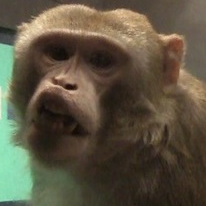
This topic is been a tricky subject to approach because no primates' vocal range compares to humans'. The closest connection has been "lipsmacking", which is exactly what it sounds like: monkeys smacking their lips at each other without vocalizing. It very common among multitude of primate species.

Lipsmacking isn't a behavior that intuitively seems like it would have a connection to human language, but it turns out that the rate at which these monkeys smack their lips together is remarkably similar to the rate at which human lips open and close when they produce speech.

Gelada's take lipsmacking a step further. It turns out that they can produce a vocalization while smacking their lips together; it is called a "wobble". A as with lipsmacks, the rhythm of these wobbles is very close to the rhythm of human speech (between 3 and 8 Hz).

As I am fond of repeating, wobbles and human language are an example of convergent evolution. Baboons don't wobble. Chimps don't wobble. All of these species lipsmack. Even though the wobble is closer to language than the lipsmack, we just aren't that closely related to geladas, so the simplest explanation is that wobbles and language evolved independently from the same foundation, lipsmacking.

Have a look for yourself. Bergman provided a video in the supplement to his new publication, here.

Wednesday, February 29

The Language of Consciousness

Thanks to the wonders of Leap Day, I can now make this post before the end of February. Tis a Leap Day Miracle. I've been doing a lot of writing lately, mostly the dry sciencey kind, but I've had time for some fun stuff on the side, so I have no excuse for not writing more here.

Today, I have a news story for you, which reveals an interesting finding: that chimpanzees are thinking about what other chimps know when they open their big mouths.


Chimpanzees consider their audience when communicating

Researchers found that wild chimps that spotted a poisonous snake were more likely to make their "alert call" in the presence of a chimp that had not seen the threat. This indicates that the animals "understand the mindset" of others.

read more...


My criticisms of the paper as they are of the news article, but seeing as the news article is what most people read, it may be of greater lasting importance.

Let me begin by saying that I am not the world's biggest fan of ape language research. In a nutshell, I believe that apes don't need to be using our version of language to communicate in a complex manner. Much of this is the fault of the news media, since the best way to connect with a lay audience is to relate findings to topics the audience is intimately familiar with. Few topics are as strong as language, in this regard.

Entirely absent from this article is any mention of Theory of Mind, which is more what this research is about than language. This is an important finding because it suggest that chimps have mental models of what other chimps know. The soft vocalization in the presence of the snake suggest that they may even model what non-conspecifics, i.e. other species, are aware of.

Most animals flat-out cannot do this. Even in primates, the ability is hotly debated. Baboons, for instance, elaborately model other baboons' relationships with members of the troop, but modeling of immediately state-of-mind is not something we have a lot of evidence to support.

The ability to comprehend that others exist in the same capacity as one's self is one of the major stepping stones to achieving consciousness. Humans have this ability, but it has been doubtful that any other species comes close. The mirror self-recognition test, one of the most difficult to pass and hotly debated tests in animal cognition, only evaluates an animal's ability to recognize its own unique existence, much less the existence of other minds. These recent findings suggest that the chimps have abilities that go far beyond self-recognition; it is very exciting work.

Monday, August 15

Missing the Point

Project Nim, the hot new film about the life and times of Nim Chimpsy, famed ape language subject, has been out in select theaters for a few weeks now. The press has been abuzz about the film, and its been received remarkably well by critics and viewers alike. Someone is my position was bound to hear a lot about it before I ever got around to seeing it, but see it I did, and now that I have, I can say a few words about how troubling a film it is.

When the director, James Marsh, was interviewed on a recent episode of The Bat Segundo Show, he repeatedly stated things like "that isn’t the film that I think would work for me" or "(that film isn't) the one I’m interested in making" when asked why he left out any mention whatsoever of other key players like Washoe and Nim's namesake, Noam Chomsky. But wait a moment, Mr. Marsh who's story is this, yours or Nim's?

Our society has entered a bountiful era of docu-dramas: The Kennedys, John Adams, The Tudors, and Frost/Nixon, just to name a few. We are inundated by colorful depictions of "history," some of which vary wildly from the known facts. I believe that in this new epoch of docu-dramas, now more than ever, films that call themselves documentaries have a responsibility to viewers, a responsibility to constructively inform.

Marsh makes it clear that his intent is to tell a story, a very particular story about the entity that was Nim. The other characters, the humans, don't really matter. They're in the movie because they need to be, without them there could be no telling of Nim's story. Once they no longer have a place in telling the story, they have no place in Marsh's movie. What results is the depressing tale of one misunderstood chimpanzee who made scientific history, but honestly got off pretty damn good compared to the vast majority of research animals. Is it accurate? The film manages to be scientifically accurate, but that isn't saying much, considering that Marsh's technique for ensuring scientific accuracy is to only include as much scientific history in the movie as is absolutely necessary.

Let us now return to my prompt, and I admit right here, that I am missing the point. If its neither about the people and how they were changed by Nim, nor the science and how it changed our understanding of our place in the world, nor the animal rights angle, then just what is a person supposed to think about after watching Project Nim?

I've been told that my "What can we learn from this? How can we act on what we learn?" mentality is part of my lot as a member of Generation Y. I've never found that to be an explanation why one shouldn't try to learn how to improve and not repeat past mistakes. Its not as if my generation was the first in a hundred years to overquote George Santayana.

These are the questions I must ask: "What are we to take away from this? What are we supposed to learn about the world around us, and in turn ourselves? How are we intended to change, as enlightened by this documentary?"

Marsh's films do not lend themselves to his approach. The problem first appeared to me when I saw Man on Wire, Marsh's first documentary film. Marsh does some ingenious stuff with style and cinematography, but the entire experience left me wanting. Look at other critically acclaimed, modern documentaries which focus on small group, like King of Kong (or Darkon, Murderball, The Woman Who Married the Eiffel Tower, and plenty of others). King of Kong is a narrative, and a compelling one at that. It also has no trouble taking the time to tell you about the people, the communities who make these stories possible, how these groups have come to exist (and persist), and why they mean something.

Man on Wire fails spectacularly at this aspect. Marsh is excellent at manipulating his audience in order to draw them into the immediate story (though personally I never managed to care that much), but in the end it falls flat. Marsh shows us an entire team of underground tightrope walkers, but who are these people? What kind of person was drawn to that ideal in the 70's? Where are they now? What did that experience mean to them in the context of the rest of their lives? Man on Wire failed to actually address the most important part of a documentary: Why should anyone care about these brief events from the 70's? What's the impact? What's the point?

I admit that I am a little bit bitter because if Project Nim were more like King of Kong, about the people who are living in a post-Nim primate research world, it would be about people like me. Instead, Project Nim is about a few people, some of whom are still involved in the primate cognition world, as they were almost 40 years ago. And its not actually about them, either! Its about Nim, except that never does Marsh ever consult any real primate ethologist to try and understand what Nim actually would have been going through during these experiences. Marsh implicitly criticizes the human in the movie for personifying Nim and not treating him like a chimpanzee, yet Marsh himself makes no effort to rise above these personifications.

Gah, the frustration mounts the more I contemplate the movie. Anyway, those are my stylistic gripes with Project Nim. Now for the ugly part.

There's some dirty, nasty deceptions of the involved humans by Marsh. I'll only point out one, but I think it is the most egregious. Marsh implies very stongly that when Nim was taken to LEMSIP, Dr. Terrace, the project leader, did nothing whatsoever to aid Nim in his plight. In fact, Terrace spearheaded the effort to have Nim released, bringing the issue to the media's attention and publicly challenging LEMSIP. Terrace offers this and other concerns in an article recently published in the LA Times.

Don't take my word for it, the situation is documented in Elizabeth Hess's book, Nim Chimpsky: The Chimp Who Would Be Human, and the particular passage is available for your reading enjoyment thanks to Google Books (provided the correct pages are up on the rotation). Hess is by no means easy on Terrace, but she gives credit where it is due.

One should note that this is the book which the movie is supposedly based on. Marsh knew what actually happened, he must have, yet he deliberately omitted that part of the story and presented Dr. Terrace in exactly the opposite light. No one in this story is an angel, but they're still people and they still have lives. Marsh refuses to apologize for any of his protrayals.

I'm not an expert in Nim's history though, so I've no idea just how much else Marsh twisted in his presentation of this history. It doesn't matter much, I simply can't condone this level of blatant misrepresentation, and it taints the entire film.

Project Nim is an interesting film to watch, in spite of the fact that it is not a very good movie. It does provide a window into the life of one very real ape, and no amount of misportrayal, deludedness, and lack of direction can make the classic, pure footage of Nim being Nim less remarkable.

Wednesday, February 16

The Southern Siamang Drawl

Crested Gibbons Sing in Different Dialects

Crested gibbons of the genus Nomascus are small apes that live in the dense rainforests of Cambodia, China, Laos and Vietnam. All seven species communicate by singing—they sing to define their territory and find a mate, and male-female pairs sing duets to strengthen their bond, rather like a Bollywood couple.

Read more...


Have any of these journalists seen a Bollywood movie?

Since I study the origins of communication, language, and not-language, this paper was hard for me to ignore. And the study subjects are gibbons! Gibbons generally are largely ignored for being boring and not-as-smart as great apes. Also, they live in the secluded treetops of Southeast Asian, and are exceedingly rare. Near Extinct kind of rare, in several cases, so its great that they're getting some publicity.

Plus, this is legitimately interesting! Its kind of like that songbird song variation, except more clustering than I've seen in birds and gibbons actually have similar brains as we do, so the research is not as totally ridiculous. Shocking!

Archaeolinguists and population geneticists have tried to connect biological evolution with the evolution of languages, and they haven't exactly failed. There are connections, or at very least correlations, in human, so finding this in gibbons is quite exciting. I hope someone looks into this in other ape species.

Link for the paper, if you so desire.

Wednesday, December 23

Noam, chomp your heart out...

I stumbled across a recent BBC story which discusses a pair of new papers which has found powerful evidence that Campbell's monkeys use syntax. Though their system is simple, they deliberately arrange sounds which modify the meaning of other vocalizations.

Many primatologists rightfully complain about how linguists are constantly shifting the tables against them. When Nim Chimpsky learned the meaning of words but couldn't arrange them together to form meaningful sentences, the results were dismissed. It was also argued that Nim was a poor experimental subject because of his unnatural upbringing and artificial environment. Many linguists appear to wish that language remain an exclusively human attribute, and certain aspects of language unquestionably are. But just where lays the line?

Since researchers have found non-human primates who make use of vocalizations as if they were suffixes (and mere monkeys, as well), primatologists are a step closer to determining precisely what linguistic capabilities other primates possess. This is a pretty neat little finding, and raises questions about how the potential development of language. Campbell's monkeys are far from great apes, so if they do possess stronger language functions than great apes, what does that say about the evolution of language in primate species?

This research was conducted by Klaus Zuberbuehler of St. Andrews and colleagues, and you can read the actual articles here and here. I also like how this stuff is getting published in PLoS ONE. The more legitimacy that journal accumulates, the better.

Be sure to check out the actual vocalizations and their variants on the BBC site.