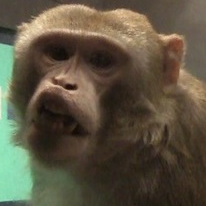
Another morning with the baboons began with two unexpected surprises. We'd had some luck scouting for all the troops the previous evening, but Tim Curry and his cohort could not be located, which happens all the time with such a small group.
As soon as we joined the main troop at dawn, I felt that something was off. The females were all agitated, and began moving quickly when they came down from the trees, despite being at a site where they usually spend some leisure time in the mornings. I circled the perimeter of the troop, looking for signs of trouble, namely the other baboon troop of Mister Timothy Curry. Sure enough, I saw Tim sitting a ways off from the troop, with his "prize" female, Terpsichore.
Terpsichore is a special kind of female. I wasn't ever one of the researchers who was into the concept of "baboon beauty," but Terp is an objectively homely baboon. Her flaws do not match the hanging jaw and breasts of Punzle, from the main troop; Terp's are more the sort of imperfections that come with old age, which makes her akin to Hilda. Terp and Hilda have very similar faces, too, I unfortunately do not have decent pictures of Terp.
Comparing Hilda and Terp isn't very effective beyond the realm of human adjudications of baboon attractiveness. Hilda is a reasonably sized female, and ranked quite high among the main troop. Terpsichore is one the largest baboons I have encountered in person, and is dead last in the local hierarchy. Much theorizing is aimed at understanding how she managed to become so huge with such poor social standing.
As Rainer would say, "no one will so much as touch her with a stick, except for Timmy." Timmy doesn't get much play these days, and all of the other females in the troop are either too stuck up or crazy (seriously, some of these females do some bizarre stuff and appear to have no self-respect for their own positions in the hierarchy), so Terp is the only one left for Tim to copulate with. And between Cyrus and Xerxes, all the females with some kind of rank are spoken for.
I digress, but it is important to emphasize how odd both Tim and Terp are. Tim and Terp idled around on the periphery of the group all morning. When the rest of the group quickly made tracks out of the sleeping site, which was almost certainly to avoid the Curries, the pair of outsiders followed.
The troop was in a state of high tension althroughout. Under many circumstances, the juveniles of the troop would relish the opportunity to spar with some new faces, but a weird old man and his mistress are not nearly as fun. Aaron took out his anger on some of the females, with Bertrand and Chester also showing palpable agitation.
Yet Tim simply would not leave. I am missing the part of the story where he wound up separated from his own troop with Terp. Perhaps he fought with Xerxes torwards the end of the previous day, and when the fight took him far from his troop, he decided to stay there overnight. That doesn't explain Terp's presence at all, though. She likes him, but she shouldn't need his protection that badly.
Speculation: clearly my favorite part about baboon blogging. Around noon, Tim and Terp finally got a clue and slowly separated form the group, returning to Tim Curry's troop. What was that clue?
Let's make a little thought experiment out of this. Throughout the day, one could hear male wahoo calls from troop members and from other baboons aways off in the forest. At some point, Tim must have recognized the wahoos of Xerxes and Cyrus, and after hearing enough of them, he could determine location, and possibly heading.
If Tim wants to get back to his troop with Terp, how would a baboon go about doing such a thing? I have a feeling that Timmy's feeble old mind may not have been up to human standards on pathfinding; my previous experience strongly suggests this. If the body of the main troop, which covers quite a sector when in a mobile foraging formation, blocked Tim's path back to his troop, he probably wouldn't be intelligent enough to follow a wide berth around the whole large troop in order to return to his own.
If Tim attempted to push through the group to his troop, he could not do so quickly and without consequence with Terp at his side. Tim might have just been an asshole and left her to fend for herself, but it turns out he didn't, for whatever reason. She wasn't at peak swell, but on the other hand, I don't follow them as much, so my knowledge of their cycles is not so strong.
Were Tim and Terp to slowly move toward his troop with the large main group in his path, the whole group would have just moved away from him, directly along his intended path, maintaining the barricade between Tim and his troop. There wouldn't have been any intentionality to this motion by Aaron and his troop, but after several hours of random walk (and being nudged by Tim) by the main troop and the TC troop, Tim and Terp could have awkwardly skirted around the main troop (displacing them further, this time in a constructive direction), and trekked back to their companions, who no doubt greeted them with repugnance. This is what transpired, at very least.
So ended Tim Curry's day off. It wasn't even a full day, to be honest, Rainer passed me reports a couple of hours after I last saw Tim, informing me that he and his female had safely returned to his eponymous troop. I didn't think to ask how the two missing baboons were welcomed on their return. Somehow, I have a feeling that Timmy gets himself lost in harmless places pretty often, and it stands to reason that the younger generation has written him off. Despite all his flaws, he has no difficultly in making sure he's taken care of by the end of the day.
Friday, June 24
Friday, June 10
Don't personify your monkeys
I apologize in advance, this is not going to be a pretty one.
Monkey "witch" burned by South African township mob
Animal welfare workers were contacted by a Kagiso resident traumatized by the incident, in which a vervet monkey was beaten, pelted with stones, shot at and burned to death.
I bring attention to this because it is bad news all-around, from the sociopathic behavior of a few people, to the racist comments made in response. The description is brief, but I would be willing to wager it was a bad kernel of a few unsavory individuals who carried out this whole thing.
In retrospect, it seems I've been reading a lot of depressing books lately, the tone of which is slipping into my writing. This endless sinus infection isn't helping matters either. See above for apology.
However, what really set me to writing was a memory brought to the surface by this article. I was once told a story by one of the white women who lived right at the forests edge, almost directly in the path of one of the troop's usual routes. One day she walked out of her house and found herself surrounded by the troop, which was leisurely passing through the yard. They can sneak up on you pretty quickly if you don't know what to look for.
In her surprise, she stumbled, and almost fell. When her bearings returned, she thought the baboons were laughing at her.
Baboons do not laugh.
Baboons will make a sound that we have onapatomeiacally dubbed a "kek." Its not as common as a grunt or a bark, but probably on par with a wahoo, at least in this population of baboons. The females use it in social interactions, it is generally issued by a female in the presence of a higher ranking female, as a way of reducing tension. The details are vague to me, and as far as I know, this is a behavior which has been studied quite little.
Cheney and Seyfarth are the go to people for modern baboon research, moreso even in Chacmas, moreso further in anything to do with vocalizations, particularly those of the females. Pretty much everything in the literature deals with "grunts," unfortunately, which means that a Kek is either being classified as a grunt, or this behavior has actually been too difficult to research.
One could reasonably argue that the Kek is ethologically derived from a grunt. In a process which is well known through Konrad Lorenz' illustration of dog behaviors, pictured below.
Along the left column, Lorenz has drawn the transition of a dog's face from calm to fearful. Along the top, he transitions to aggressive. The other pictures are combinations of the facial expressions at various stages, culminating in the lower right picture, which depicts full on fear and aggression in concert.
The Kek could be the result of a comparable combination. The female might have adopted a grimace of fear, distorting her cheeks and and tightening her facial muscles. While trying to grunt to another baboon in an affiliative manner, the twisting and tightening of muscles could distort the sound of the call, producing a Kek. If this is what is happening, ought we still to call this a "grunt"? If a human observer can distinguish between the two, then a baboon can unquestionably discern a difference in meaning as well.
To make an overly ruminative explanation short, the Kek sounds a bit like a mean spirited laugh, and regardless of what a Kek really means to a baboon, it definitely is not a form of laughter. This story is one of coincidence, but in light of what happened to that vervet, I must be thankful that this encounter involved an enlightened Capetonian, and that baboons are way bigger and scarier than vervets.
There is a sad lack of publicly available baboon sounds that one can find on the web. However, I did find this. There are no Kek'ing sounds included, and some files are mislabeled, but they are all sounds one would hear from a baboon. Have a look if you've got the urge. I'll keep looking for Kek sounds; I may yet be able to dig a few up.
Monkey "witch" burned by South African township mob
Animal welfare workers were contacted by a Kagiso resident traumatized by the incident, in which a vervet monkey was beaten, pelted with stones, shot at and burned to death.
I bring attention to this because it is bad news all-around, from the sociopathic behavior of a few people, to the racist comments made in response. The description is brief, but I would be willing to wager it was a bad kernel of a few unsavory individuals who carried out this whole thing.
In retrospect, it seems I've been reading a lot of depressing books lately, the tone of which is slipping into my writing. This endless sinus infection isn't helping matters either. See above for apology.
However, what really set me to writing was a memory brought to the surface by this article. I was once told a story by one of the white women who lived right at the forests edge, almost directly in the path of one of the troop's usual routes. One day she walked out of her house and found herself surrounded by the troop, which was leisurely passing through the yard. They can sneak up on you pretty quickly if you don't know what to look for.
In her surprise, she stumbled, and almost fell. When her bearings returned, she thought the baboons were laughing at her.
Baboons do not laugh.
Baboons will make a sound that we have onapatomeiacally dubbed a "kek." Its not as common as a grunt or a bark, but probably on par with a wahoo, at least in this population of baboons. The females use it in social interactions, it is generally issued by a female in the presence of a higher ranking female, as a way of reducing tension. The details are vague to me, and as far as I know, this is a behavior which has been studied quite little.
Cheney and Seyfarth are the go to people for modern baboon research, moreso even in Chacmas, moreso further in anything to do with vocalizations, particularly those of the females. Pretty much everything in the literature deals with "grunts," unfortunately, which means that a Kek is either being classified as a grunt, or this behavior has actually been too difficult to research.
One could reasonably argue that the Kek is ethologically derived from a grunt. In a process which is well known through Konrad Lorenz' illustration of dog behaviors, pictured below.
Along the left column, Lorenz has drawn the transition of a dog's face from calm to fearful. Along the top, he transitions to aggressive. The other pictures are combinations of the facial expressions at various stages, culminating in the lower right picture, which depicts full on fear and aggression in concert.
The Kek could be the result of a comparable combination. The female might have adopted a grimace of fear, distorting her cheeks and and tightening her facial muscles. While trying to grunt to another baboon in an affiliative manner, the twisting and tightening of muscles could distort the sound of the call, producing a Kek. If this is what is happening, ought we still to call this a "grunt"? If a human observer can distinguish between the two, then a baboon can unquestionably discern a difference in meaning as well.
To make an overly ruminative explanation short, the Kek sounds a bit like a mean spirited laugh, and regardless of what a Kek really means to a baboon, it definitely is not a form of laughter. This story is one of coincidence, but in light of what happened to that vervet, I must be thankful that this encounter involved an enlightened Capetonian, and that baboons are way bigger and scarier than vervets.
There is a sad lack of publicly available baboon sounds that one can find on the web. However, I did find this. There are no Kek'ing sounds included, and some files are mislabeled, but they are all sounds one would hear from a baboon. Have a look if you've got the urge. I'll keep looking for Kek sounds; I may yet be able to dig a few up.
Wednesday, May 25
Wound Up
Big news in primatology, or well, there's always "big" news, I just seldom get around to talking about it until I simply can't keep track of all the stories because my firefox session becomes so slow due to all the tabs I have open. I'm not quite sure what that says about my work ethic.
First, the baboons:
‘Feeding stations’: an answer to conflict?
Baboons foraging in human areas leads to highly undesirable consequences
A question that is being asked of baboon management on a regular basis is whether using feeding stations (or provisioning) can be used to draw baboons away from human areas, where humans and baboons often conflict with one another. In this post we address the question, based on data we have collected . . .
This post is particularly notable because it utilizes some of the actual data that have came out of the BRU projects, in order to make informed recommendations about what to do about the Cape Town groups.
We spent so much time musing over the various proposals for how to keep the baboons apart, its great to see some facts coming to light. Even though the results aren't positive, its at least one option off the floor, narrowing the debate considerably.
The actual big news concerns the gorillas, and might be well known to everyone by now. I was a little slow on the uptake, though the difficulty I am having in finding the original story is making me feel a little better about myself. Oh, that's why, it was from theNewScientist. Shit. Fine, I'll give you the journal reference, none of their noise.
Local traditions in gorilla manual skill: evidence for observational learning of behavioral organization
Elaborate manual skills of food processing are known in several species of great ape; but their manner of acquisition is controversial. Local, “cultural” traditions show the influence of social learning, but it is uncertain whether this includes the ability to imitate the organization of behavior. Dispute has centered on whether program-level imitation contributes to the acquisition of feeding techniques in gorillas. Here, we show that captive western gorillas at Port Lympne, Kent, have developed a group-wide habit of feeding on nettles . . .
The premise here is pretty simple, if you're familiar with the related chimpanzee research. Chimps are known to be able to spread knowledge and techniques among groups, techniques like the famous Use-a-Stick-to-Fish-Some-Tasty-Bugs-Out-of-a-Hole approach. This is the first example of any such evidence in gorillas, which is good news for them, since as far as apes go, gorillas are not known for their intellect, much less tool use. This sort of research drives right at the heart of cultural foundations, one of the least understood concepts, from an ethological perspective, regardless of what a sociologist might tell you.
One of the advisors of one of my advisors worked on this research and paper, so that means it is much more believable research than most other stuff being published... in anything.
This next one bring me backs to my neuroscience days when I studied a fascinating behavior in rats, whereby they were able to transmit taste preferences between rats by breathing tastes and special signal chemicals at each other, in conjunction.
Bonobos 'chat' about good foods
In the first study of its kind, researchers in the UK found the apes gave each other specific details about food quality. The combination of five distinct calls into sequences allowed others to concentrate their foraging around areas known to contain preferred kiwi fruits.
Bononbos be smart. More and more, I get the feeling that if I had to choose between chimps and bonobos in a dream job, I would choose bonobos. I still have my reservations, but chimps often do not seem nearly as interesting when you take them out of the wild. These bonobos were studied entirely in captivity! What I really want to know now is the life history of the animals, and the results line up with that. Also what this Twycross Zoo is all about since it is apparently the World Primate Center.
To conclude, I have an amusing bit of research to share.
I can't wait to see how much (and what kind of...) mileage I can get out of these results.
Apparently women (but not men) like monkey sex… literally.
Previous research suggests that women’s genital arousal is an automatic response to sexual stimuli, whereas men’s genital arousal is dependent upon stimulus features specific to their sexual interests. In this study, we tested the hypothesis that a nonhuman sexual stimulus would elicit a genital response in women but not in men.
First, the baboons:
‘Feeding stations’: an answer to conflict?
Baboons foraging in human areas leads to highly undesirable consequences
A question that is being asked of baboon management on a regular basis is whether using feeding stations (or provisioning) can be used to draw baboons away from human areas, where humans and baboons often conflict with one another. In this post we address the question, based on data we have collected . . .
This post is particularly notable because it utilizes some of the actual data that have came out of the BRU projects, in order to make informed recommendations about what to do about the Cape Town groups.
We spent so much time musing over the various proposals for how to keep the baboons apart, its great to see some facts coming to light. Even though the results aren't positive, its at least one option off the floor, narrowing the debate considerably.
The actual big news concerns the gorillas, and might be well known to everyone by now. I was a little slow on the uptake, though the difficulty I am having in finding the original story is making me feel a little better about myself. Oh, that's why, it was from theNewScientist. Shit. Fine, I'll give you the journal reference, none of their noise.
Local traditions in gorilla manual skill: evidence for observational learning of behavioral organization
Elaborate manual skills of food processing are known in several species of great ape; but their manner of acquisition is controversial. Local, “cultural” traditions show the influence of social learning, but it is uncertain whether this includes the ability to imitate the organization of behavior. Dispute has centered on whether program-level imitation contributes to the acquisition of feeding techniques in gorillas. Here, we show that captive western gorillas at Port Lympne, Kent, have developed a group-wide habit of feeding on nettles . . .
The premise here is pretty simple, if you're familiar with the related chimpanzee research. Chimps are known to be able to spread knowledge and techniques among groups, techniques like the famous Use-a-Stick-to-Fish-Some-Tasty-Bugs-Out-of-a-Hole approach. This is the first example of any such evidence in gorillas, which is good news for them, since as far as apes go, gorillas are not known for their intellect, much less tool use. This sort of research drives right at the heart of cultural foundations, one of the least understood concepts, from an ethological perspective, regardless of what a sociologist might tell you.
One of the advisors of one of my advisors worked on this research and paper, so that means it is much more believable research than most other stuff being published... in anything.
This next one bring me backs to my neuroscience days when I studied a fascinating behavior in rats, whereby they were able to transmit taste preferences between rats by breathing tastes and special signal chemicals at each other, in conjunction.
Bonobos 'chat' about good foods
In the first study of its kind, researchers in the UK found the apes gave each other specific details about food quality. The combination of five distinct calls into sequences allowed others to concentrate their foraging around areas known to contain preferred kiwi fruits.
Bononbos be smart. More and more, I get the feeling that if I had to choose between chimps and bonobos in a dream job, I would choose bonobos. I still have my reservations, but chimps often do not seem nearly as interesting when you take them out of the wild. These bonobos were studied entirely in captivity! What I really want to know now is the life history of the animals, and the results line up with that. Also what this Twycross Zoo is all about since it is apparently the World Primate Center.
To conclude, I have an amusing bit of research to share.
I can't wait to see how much (and what kind of...) mileage I can get out of these results.
Apparently women (but not men) like monkey sex… literally.
Previous research suggests that women’s genital arousal is an automatic response to sexual stimuli, whereas men’s genital arousal is dependent upon stimulus features specific to their sexual interests. In this study, we tested the hypothesis that a nonhuman sexual stimulus would elicit a genital response in women but not in men.
Friday, May 13
On the definition of a monkey
This one is mostly for the benefit of Buzz.
Yes, apes are monkeys and therefore so are we. I’ve said it before and I’ve given my reasons, other biology types have said it and given their reasons, yet a crime against pedantry rages unabated.
... from Zygoma.
The author, PaoloV is in osteology, which means he might well be working with different primate species all the time, but I just can't bring myself to consider working with dead primates to being on the same footing as working with live primates. We all have our flaws.
Truthfully, the distinction between monkey and ape is a handy one to have. There are too many people I meet (smart people, too) who do not understand the vast difference between a chimpanzee and a spider monkey, thinking of them both as "monkeys." Maybe I ought to devote an entire Human Ethology post to this, but I don't think people are naturally inclined towards understanding the distinction between inclusive and non-inclusive sets. Its definitely easier to think, "okay they're closely related, but a monkey is one thing and an ape is another." And its even easier to think "anything that swings around and makes hooting noises is a monkey."
I really like the word "monkey," however. Its such a fun pair of syllables, so I would not be opposed to being given more opportunities to use the word. Its unfortunate that there the two main distinctions within are Old World and New World Monkeys. In that case, shouldn't we be assigned some kind of monkey subtitle?
In conclusion, I have no strong opinion one way or the other, though I may wind up changing the name of this blog to Lord of the Monkeys at some point, to promote greater journalistic integrity.
Yes, apes are monkeys and therefore so are we. I’ve said it before and I’ve given my reasons, other biology types have said it and given their reasons, yet a crime against pedantry rages unabated.
... from Zygoma.
The author, PaoloV is in osteology, which means he might well be working with different primate species all the time, but I just can't bring myself to consider working with dead primates to being on the same footing as working with live primates. We all have our flaws.
Truthfully, the distinction between monkey and ape is a handy one to have. There are too many people I meet (smart people, too) who do not understand the vast difference between a chimpanzee and a spider monkey, thinking of them both as "monkeys." Maybe I ought to devote an entire Human Ethology post to this, but I don't think people are naturally inclined towards understanding the distinction between inclusive and non-inclusive sets. Its definitely easier to think, "okay they're closely related, but a monkey is one thing and an ape is another." And its even easier to think "anything that swings around and makes hooting noises is a monkey."
I really like the word "monkey," however. Its such a fun pair of syllables, so I would not be opposed to being given more opportunities to use the word. Its unfortunate that there the two main distinctions within are Old World and New World Monkeys. In that case, shouldn't we be assigned some kind of monkey subtitle?
In conclusion, I have no strong opinion one way or the other, though I may wind up changing the name of this blog to Lord of the Monkeys at some point, to promote greater journalistic integrity.
Monday, May 9
More Latest Stuffs on Altruism
At the time, I didn't write much about the Martin Nowab et al. paper which appeared in Nature about a year back, but it generated a bunch a hubbub mostly because everyone thought they were completely wrong.
I thought they were completely wrong, initially. Kin Selection is a wonderfully simple and elegant concept, that is honestly hard to imagine as possibly being wrong. Its too simple and fundamental. I also didn't want it to be wrong because it underlies many of my own core beliefs and personal theories (yes I admit I am allowing my confirmation bias to work here).
In all fairness, I still think they are wrong. I looked around in the months after the initial release, and was satisfied by the refutations from everyone else in the community.
Somehow, the topic came up again more recently and I went back to the original paper. I checked the supplementary materials, unsure if I had looked at them the first time.
I had not. They are almost an entirely new and different paper from the one that actually appears in print. I considered going through this monster 40+ page adversary and critiquing it page by page, but that seemed like it might become a full-time job for a few months, what with having to relearn all of Nowak's obscure mathematical presentations.
Then another article appeared in Science, about ROBOTS and simulations of kin selection in those models. Good read. Yet, Nowak's comment at the end reignited my ire. In orther sources, Nowak says that the critics aren't really going through all of their arguments no matter how many hundreds of scientists print that they're wrong. Its like he's some kind of avate-garde hipster scientist.
Truth be told, I really didn't want to be the one to "go through all their arguments," and very fortunately, someone else came close enough for my tastes, just recently, too.
Rousset and Leon actually tear away at the paper and its supplements, and, because their commentary was not published in Nature like that giant series from March, they can make some much needed criticisms of this article in context.
Rousset F, & Lion S (2011). Much ado about nothing: Nowak et al.'s charge against inclusive fitness theory. Journal of evolutionary biology PMID: 21457170
I thought they were completely wrong, initially. Kin Selection is a wonderfully simple and elegant concept, that is honestly hard to imagine as possibly being wrong. Its too simple and fundamental. I also didn't want it to be wrong because it underlies many of my own core beliefs and personal theories (yes I admit I am allowing my confirmation bias to work here).
In all fairness, I still think they are wrong. I looked around in the months after the initial release, and was satisfied by the refutations from everyone else in the community.
Somehow, the topic came up again more recently and I went back to the original paper. I checked the supplementary materials, unsure if I had looked at them the first time.
I had not. They are almost an entirely new and different paper from the one that actually appears in print. I considered going through this monster 40+ page adversary and critiquing it page by page, but that seemed like it might become a full-time job for a few months, what with having to relearn all of Nowak's obscure mathematical presentations.
Then another article appeared in Science, about ROBOTS and simulations of kin selection in those models. Good read. Yet, Nowak's comment at the end reignited my ire. In orther sources, Nowak says that the critics aren't really going through all of their arguments no matter how many hundreds of scientists print that they're wrong. Its like he's some kind of avate-garde hipster scientist.
Truth be told, I really didn't want to be the one to "go through all their arguments," and very fortunately, someone else came close enough for my tastes, just recently, too.
Rousset and Leon actually tear away at the paper and its supplements, and, because their commentary was not published in Nature like that giant series from March, they can make some much needed criticisms of this article in context.
"The format of the paper itself is an obstacle to scientific communication. The article has two parts: a short illustrated essay for the general reader and a 43-page online mathematical Appendix. Readers who are not mathematically inclined or simply short on time may be tempted to simply trust the authors and gauge the scientific value of the paper based on the ‘weight’ of the supplementary material or on the prestige of the authors."Thank you, Rousset and Leon. Regardless of the validity of the results, the paper's presentation is a travesty; a travesty that the authors were fully aware of. Devastating stuff, and I really hope everyone involved or even watching has learned a constructive lesson or two from this catastrophe. Now hopefully I can be satisfied that Nowak et al. have been properly refuted.
Rousset F, & Lion S (2011). Much ado about nothing: Nowak et al.'s charge against inclusive fitness theory. Journal of evolutionary biology PMID: 21457170
Tuesday, May 3
More Baboon Video
There's a new episode of Baboons with Bill Bailey out:
I also discovered that they're taking the eps down after a couple of weeks, so absolutely watch this one as soon as you have the time. Its mostly Da Gama baboons, but there's a few minutes of Tokai, featuring the young male, Clint.
That guy has got nothing. I ought to feel sorry for him since the troop he comes from is overloaded with males, and he's the youngest and smallest out of them, but he never made himself stand out. There are some pretty exceptional young baboons in that troop, if I may say so myself... More on that later.
I don't like the guy much, but my bet is still on Dani.
I also discovered that they're taking the eps down after a couple of weeks, so absolutely watch this one as soon as you have the time. Its mostly Da Gama baboons, but there's a few minutes of Tokai, featuring the young male, Clint.
That guy has got nothing. I ought to feel sorry for him since the troop he comes from is overloaded with males, and he's the youngest and smallest out of them, but he never made himself stand out. There are some pretty exceptional young baboons in that troop, if I may say so myself... More on that later.
I don't like the guy much, but my bet is still on Dani.
Thursday, April 28
Queen me?
I'm in the process of writing a paper concerning the ecology and industry of American bison (meat), so my writing engine is low on fuel.
But, a friend sent me this article about bees that I have found myself suprisingly pleased with. Sure, its about insects, but for someone who doesn't spend much time reading entomology papers, it can be rather refreshing. Plus, I would not dream of understating the importance of entomology to the development of the fields of ethology and sociobiology. The fact that I learned about the paper via theNewScientist is less forgivable.
I honestly had no idea how Queens became differetiated from other bees, we just didn't even get into it in Animal Behavior, other than a brief discussion of "royal jelly" which came across almost as an old wives' tale. These folks are lucky that they found such a clear effect from a single compound. A single author, too... most impressive. So, how do Queens come to be in ants, termites, and other eusocial insects?
Anyway, there's your dose of 'real' ethology; the only one you'll get from me for the foreseeable future.
But, a friend sent me this article about bees that I have found myself suprisingly pleased with. Sure, its about insects, but for someone who doesn't spend much time reading entomology papers, it can be rather refreshing. Plus, I would not dream of understating the importance of entomology to the development of the fields of ethology and sociobiology. The fact that I learned about the paper via theNewScientist is less forgivable.
I honestly had no idea how Queens became differetiated from other bees, we just didn't even get into it in Animal Behavior, other than a brief discussion of "royal jelly" which came across almost as an old wives' tale. These folks are lucky that they found such a clear effect from a single compound. A single author, too... most impressive. So, how do Queens come to be in ants, termites, and other eusocial insects?
Anyway, there's your dose of 'real' ethology; the only one you'll get from me for the foreseeable future.
Wednesday, April 20
Every primate's a little bit prejudiced
Scientific American covered a new article out in the Journal of Personality and Social Psychology which asks an interesting question, of a sort that is not asked nearly enough, in my opinion. Are our biases and attitudes towards other social groups, and within our own group, uniquely human? Do our strategies arise from experiences which no other species can match?
The answer provided by Neha Mahajan, Laurie Santos and colleagues is no.
Once does the SciAm article mentioned "racism," but its in their subtitle. They shouldn't have done this. This cannot be shown to be racism, not under the current conditions. If some sort of morphological or genetic analysis was performed, then maybe they could make this claim. But all the associations in this research are social, not biological. Unless you believe race is a purely social institution, but people have known for a while that its just not that simple.
The true question is easily found in the abstract, and I've paraphrased it above. Did SciAm have access to the full length article, and I missing something with just the abstract? I assume so, though it is rather odd for their link to take the reader to an abstract with no sign of the full text. Even with my various University sources, I couldn't manage to obtain access to this article. So all I have to go by is the abstract, same as you. Ultimately, even if I wanted to, I couldn't write a critical assessment of the source document.
Thus ends this cautionary tale. I am all in favor of more research like this, and other research which truly investigates the genetic basis for ethnic group biases. However, the story of race, genetics, and scientific inquiry is a troubled one. One SciAm article isn't a huge deal, but it demonstrates how easy it is to make little mistakes, and the pursuit of knowledge in this discipline is a razor thin line which must be carefully walked. Otherwise, unfortunate things can happen.
The answer provided by Neha Mahajan, Laurie Santos and colleagues is no.
"We found the first evidence that a nonhuman species automatically distinguishes the faces of members of its own social group from those in other groups and displays greater vigilance toward outgroup members . . . macaques spontaneously associate novel objects with specific social groups and display greater vigilance to objects associated with outgroup members . . . and we discovered that macaques, like humans, automatically evaluate ingroup members positively and outgroup members negatively."I won't lie, this is some really intriguing stuff. You can read all this and more on the details in SciAm's article, and I hate to rehash thing that have already been said. Rather, I'd like to switch attention to the spin which SciAm puts on this article in their own report.
Once does the SciAm article mentioned "racism," but its in their subtitle. They shouldn't have done this. This cannot be shown to be racism, not under the current conditions. If some sort of morphological or genetic analysis was performed, then maybe they could make this claim. But all the associations in this research are social, not biological. Unless you believe race is a purely social institution, but people have known for a while that its just not that simple.
The true question is easily found in the abstract, and I've paraphrased it above. Did SciAm have access to the full length article, and I missing something with just the abstract? I assume so, though it is rather odd for their link to take the reader to an abstract with no sign of the full text. Even with my various University sources, I couldn't manage to obtain access to this article. So all I have to go by is the abstract, same as you. Ultimately, even if I wanted to, I couldn't write a critical assessment of the source document.
Thus ends this cautionary tale. I am all in favor of more research like this, and other research which truly investigates the genetic basis for ethnic group biases. However, the story of race, genetics, and scientific inquiry is a troubled one. One SciAm article isn't a huge deal, but it demonstrates how easy it is to make little mistakes, and the pursuit of knowledge in this discipline is a razor thin line which must be carefully walked. Otherwise, unfortunate things can happen.
Thursday, April 14
My monkeys are famous on the internet!
Okay not really. Not yet. There's only a few hundred views at time of this posting. But its TV! Real... British TV...
Another thing about this video is that its quite recent. Not so recent as Fred's untimely demise, as that baboon plays a major role in this video. Its quite a good video, too, comapred to the media I'm used to seeing surrounding these baboons. Bill Bailey doesn't make any judgements on what the baboons are doing, and he mostly chastises humans for being clearly dumb and not protecting their valuables. There are several minor errors, and more than a few leaps to conclusions, but that is The Science talking.
The Tokai troop in this video is my troop, though. You won't recognize the names because they have been changed to protect the innocent. Though one of these days I may reveal the unadulterated truth of these baboon tales. Dani's certainly grown into the hide and build of an alpha male, though.
There are some oddities (minor errors, perhaps, as I alluded to earlier), which I could go on about for pages, but I'll stick to some of the more interesting ones. Bailey implies that the Smitz baboons know that the whales are why the humans come to that area. I won't rule out the possibility that they might be doing this, but Occam's Razor suggest otherwise. Have a look at the terrain - its steep fynbos all around. That troop doesn't need to know about whales or the whale watching season, they only need to know that foolish humans with food tend to congregate along that coast line on a regular basis. Then they can peer down from where they might sleep on the outcroppings and see if the humans are lining up as easy pickings on any given day.
In Tokai, Whitey is far from the oldest female around. She wasn't even one of the females I included in the Old Ladies Club. The leg injury is not likely to be permanent. There is a Limper in the other troop, who I figured would recover, but simply never did, however, so Whitey might be stuck that way. Hard to say. As the film shows, and as I always say, being a female baboon is rough. Easy work for the filmmakers, on the other hand; there is a good chance that any day they were to come by, one of the big males would pick on one of the females. I did like the fact that Bailey acted properly confused as to what particular reason Dani had for chasing Berta on this particular day.
Even if you don't care for the narration, the footage is some of the best (and longest) you'll find anywhere. Definitely worth the watch. It would have been worth it just for that shot of Stettler, sitting in the forest. The old man always was my favorite.
Another thing about this video is that its quite recent. Not so recent as Fred's untimely demise, as that baboon plays a major role in this video. Its quite a good video, too, comapred to the media I'm used to seeing surrounding these baboons. Bill Bailey doesn't make any judgements on what the baboons are doing, and he mostly chastises humans for being clearly dumb and not protecting their valuables. There are several minor errors, and more than a few leaps to conclusions, but that is The Science talking.
The Tokai troop in this video is my troop, though. You won't recognize the names because they have been changed to protect the innocent. Though one of these days I may reveal the unadulterated truth of these baboon tales. Dani's certainly grown into the hide and build of an alpha male, though.
There are some oddities (minor errors, perhaps, as I alluded to earlier), which I could go on about for pages, but I'll stick to some of the more interesting ones. Bailey implies that the Smitz baboons know that the whales are why the humans come to that area. I won't rule out the possibility that they might be doing this, but Occam's Razor suggest otherwise. Have a look at the terrain - its steep fynbos all around. That troop doesn't need to know about whales or the whale watching season, they only need to know that foolish humans with food tend to congregate along that coast line on a regular basis. Then they can peer down from where they might sleep on the outcroppings and see if the humans are lining up as easy pickings on any given day.
In Tokai, Whitey is far from the oldest female around. She wasn't even one of the females I included in the Old Ladies Club. The leg injury is not likely to be permanent. There is a Limper in the other troop, who I figured would recover, but simply never did, however, so Whitey might be stuck that way. Hard to say. As the film shows, and as I always say, being a female baboon is rough. Easy work for the filmmakers, on the other hand; there is a good chance that any day they were to come by, one of the big males would pick on one of the females. I did like the fact that Bailey acted properly confused as to what particular reason Dani had for chasing Berta on this particular day.
Even if you don't care for the narration, the footage is some of the best (and longest) you'll find anywhere. Definitely worth the watch. It would have been worth it just for that shot of Stettler, sitting in the forest. The old man always was my favorite.
Wednesday, March 30
A Solemn Farewell
South Africa Euthanizes Well-Known Baboon
CAPE TOWN, South Africa (AP) — South African officials said Friday that they had euthanized the country's most famous baboon, known as Fred, who was well-known for raiding cars and frightening tourists along Cape Town's scenic route. Read more...
I didn't know Fred. I know a different baboon by that name, which was pure coincidence. Our baboons generally had odd names, which is what happens when someone lets me name anything. On the other hand, there is a cohort of well-known males scattered around the Cape Peninsula, with simple, friendly names like Fred, David, George, and Erik.
Right there is one place this story goes odd. As far as I have ever known, Erik is the most famous male baboon on the Cape Peninsula, since he is incredibly old, but quite active, and apparently manages to maintain legitimate alpha male status among his troop (I've heard that from sources I actually probably can trust), despite being over 20. See, that's old.
Calling Fred a "ringleader" was an odd choice. I suppose that could makes sense from a troop mind perspective, but I'm sure that wasn't what was running through the author's mind when he wrote it. I suppose that the paragraph is technically not incorrect, but they sure made the event sound like some kind of tactical black ops mission:
However, if opening car doors truly was Fred's signature move, then I might have seen him on one of his raids while driving past Simon's Town. A large male opened someone's back door and stole their sandwich and bag of crisps. On the other hand, I've seen an awful lot of baboons try (and sometimes succeed at) opening car doors, so I would not consider this behavior to be any baboon's signature.
Nevertheless, it is as the baboon management group says, "this baboon's demise can be contributed mainly to the continuous misguided efforts by humans to befriend and feed baboons." See you space... monkey.
CAPE TOWN, South Africa (AP) — South African officials said Friday that they had euthanized the country's most famous baboon, known as Fred, who was well-known for raiding cars and frightening tourists along Cape Town's scenic route. Read more...
I didn't know Fred. I know a different baboon by that name, which was pure coincidence. Our baboons generally had odd names, which is what happens when someone lets me name anything. On the other hand, there is a cohort of well-known males scattered around the Cape Peninsula, with simple, friendly names like Fred, David, George, and Erik.
Right there is one place this story goes odd. As far as I have ever known, Erik is the most famous male baboon on the Cape Peninsula, since he is incredibly old, but quite active, and apparently manages to maintain legitimate alpha male status among his troop (I've heard that from sources I actually probably can trust), despite being over 20. See, that's old.
Calling Fred a "ringleader" was an odd choice. I suppose that could makes sense from a troop mind perspective, but I'm sure that wasn't what was running through the author's mind when he wrote it. I suppose that the paragraph is technically not incorrect, but they sure made the event sound like some kind of tactical black ops mission:
"In 2009, Fred led a group of 29 baboons in a four-car raid outside Simon's Town, a small coastal neighborhood. The baboon chief used his signature tactic of opening unlocked doors and jumping through windows to search for food, while the rest looked for access inside from car roofs and hoods."Last time was in 2009? I assure you those baboons raided much more recently than that. Its such an odd paragraph for anyone who knows anything. Its like the author googled "Fred baboon Cape Town" and only looked at the first news result that cropped up.
However, if opening car doors truly was Fred's signature move, then I might have seen him on one of his raids while driving past Simon's Town. A large male opened someone's back door and stole their sandwich and bag of crisps. On the other hand, I've seen an awful lot of baboons try (and sometimes succeed at) opening car doors, so I would not consider this behavior to be any baboon's signature.
Nevertheless, it is as the baboon management group says, "this baboon's demise can be contributed mainly to the continuous misguided efforts by humans to befriend and feed baboons." See you space... monkey.
Subscribe to:
Posts (Atom)