
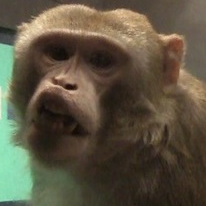
A few weeks have passed since Iran claimed to have sent a monkey to space and back. It did not take long for skeptics to point out that the two monkeys look nothing alike. I can't begin to explain why Iran wouldn't do a better job staging their publicity photographs. My mind has been occupied with (in my opinion) a more interesting question: Why is it easy to distinguish between individuals of some primate species, but not others?
I've spent time with a number of primate species, but in terms of sheer hours of exposure, chacma baboons and rhesus macaques take the top two slots. I know both these species very well. Yet, rhesus macaques are easy for me to distinguish between, while chacma baboons are exceptionally difficult to identify. After spending a few hours with some macaques, I can reliably tell you their name and personality, mostly from looking at their faces. After spending hundreds of hours with the same baboons, I could not tell them apart, at least not based on their faces. They really do all look the same. Its more effective to look at the pattern of tears on their ears, and the shape of the callosities on their rumps. Its quite humbling, actually.
A similar phenomena exists in humans, known as the Cross-Race Effect. Or, as the All Look Same effect. In humans, the difference is based on race, but its not racism. How much of the effect can be explained by nature versus nurture is a matter of contention, but has everything to do with an individual's upbringing, who the individual spends time around as they grow up.
The monkey face recognition effect must be different because I didn't grow up spending large amounts of time around rhesus monkeys. So, I turned to genetic diversity for ideas. The more diverse a species is, the easier it should be to identify within the species. It stands to reason that the species which is much easier to identify (rhesus macaques) would have higher genetic diversity.
Research started off easy. The rhesus macaque is three times as diverse but more closely equivalent in damaging coding variation as compared to the human. That is about as straight forward an answer as I have ever seen in the title of an academic publication. Okay, so what about chacma baboons?
Baboon diversity is not as well understood. Rhesus monkeys are widespread, plus they're the animal of choice when it comes to biomedical research. Baboons are also widespread, and favorites of field researchers. But you don't see them as much in labs, so genetic testing is not a routine procedure. Nonetheless, I found an article which addresses my questions.
Quantifying diversity is a not a simple matter. From data collection to bio-informatic analysis, it can be a bumpy road. I don't know why exactly Newman et al. chose to quantify diversity with the mean percent pairwise difference in haplotypes, but it happens to be pretty easy to explain. To use the metric, you take your data, a set of DNA samples from individual monkeys, and compare each individual's DNA to everyone else's within the same species. You count the number of differences observed between individual base pairs at the same places in the DNA sequences. Then, convert that number into a percentage, and finally, average all of the comparisons between individuals. That's the author's measure of within species diversity.
The diversity found in rhesus macaques was 4.2%. In chacma baboons, it was 0.9%. That is a considerable difference. These numbers are only given a small mention in this part of the paper, so I don't know the margins of error. Nevertheless, these finding support the hypothesis that baboons are harder to distinguish because there is really is less distinguishing information available; less diversity within the species.
However, there are some extenuating circumstances. The baboons I interact with in Cape Town are from a small population, in fact, a subspecies of chacma baboon, Papio ursinus ursinus. Now their diversity is cut down even further, possibly by an order of magnitude or more.
Most of the rhesus macaques I've spent time with were in captive colonies. There are many rhesus sub-species; no one knows the pedigree of colony monkeys, another dirty secret of the biomedical community. But, my best guess is that they came from rhesus populations as wide spread as you can imagine, so the diversity in colonies is likely to approach 4.2%. I have interacted with wild groups of rhesus macaques, but only for short periods (hours), not for months as I have with the baboons. Are they more difficult to identify than the captive monkeys I know? Yes, they are, but not as difficult as wild baboons.
Which raises a follow-up question: What is the right way to quantify how easy it is to tell members of a species or sub-species apart? My gut feelings aren't going to hold up under scrutiny. Appropriate paradigms already exist: show people (or monkeys) a series of faces, some new some repeated, and ask them if they've seen each one before. As I've heard many Professors say (to myself and others around me), "you could get a thesis out of these experiments."
Yuan, Q., Zhou, Z., Lindell, S., Higley, J., Ferguson, B., Thompson, R., Lopez, J., Suomi, S., Baghal, B., Baker, M., Mash, D., Barr, C., & Goldman, D. (2012). The rhesus macaque is three times as diverse but more closely equivalent in damaging coding variation as compared to the human BMC Genetics, 13 (1) DOI: 10.1186/1471-2156-13-52
Newman, T., Jolly, C., & Rogers, J. (2004). Mitochondrial phylogeny and systematics of baboons (Papio) American Journal of Physical Anthropology, 124 (1), 17-27 DOI: 10.1002/ajpa.10340
I've spent time with a number of primate species, but in terms of sheer hours of exposure, chacma baboons and rhesus macaques take the top two slots. I know both these species very well. Yet, rhesus macaques are easy for me to distinguish between, while chacma baboons are exceptionally difficult to identify. After spending a few hours with some macaques, I can reliably tell you their name and personality, mostly from looking at their faces. After spending hundreds of hours with the same baboons, I could not tell them apart, at least not based on their faces. They really do all look the same. Its more effective to look at the pattern of tears on their ears, and the shape of the callosities on their rumps. Its quite humbling, actually.
A similar phenomena exists in humans, known as the Cross-Race Effect. Or, as the All Look Same effect. In humans, the difference is based on race, but its not racism. How much of the effect can be explained by nature versus nurture is a matter of contention, but has everything to do with an individual's upbringing, who the individual spends time around as they grow up.
The monkey face recognition effect must be different because I didn't grow up spending large amounts of time around rhesus monkeys. So, I turned to genetic diversity for ideas. The more diverse a species is, the easier it should be to identify within the species. It stands to reason that the species which is much easier to identify (rhesus macaques) would have higher genetic diversity.
Research started off easy. The rhesus macaque is three times as diverse but more closely equivalent in damaging coding variation as compared to the human. That is about as straight forward an answer as I have ever seen in the title of an academic publication. Okay, so what about chacma baboons?
Baboon diversity is not as well understood. Rhesus monkeys are widespread, plus they're the animal of choice when it comes to biomedical research. Baboons are also widespread, and favorites of field researchers. But you don't see them as much in labs, so genetic testing is not a routine procedure. Nonetheless, I found an article which addresses my questions.
Quantifying diversity is a not a simple matter. From data collection to bio-informatic analysis, it can be a bumpy road. I don't know why exactly Newman et al. chose to quantify diversity with the mean percent pairwise difference in haplotypes, but it happens to be pretty easy to explain. To use the metric, you take your data, a set of DNA samples from individual monkeys, and compare each individual's DNA to everyone else's within the same species. You count the number of differences observed between individual base pairs at the same places in the DNA sequences. Then, convert that number into a percentage, and finally, average all of the comparisons between individuals. That's the author's measure of within species diversity.
The diversity found in rhesus macaques was 4.2%. In chacma baboons, it was 0.9%. That is a considerable difference. These numbers are only given a small mention in this part of the paper, so I don't know the margins of error. Nevertheless, these finding support the hypothesis that baboons are harder to distinguish because there is really is less distinguishing information available; less diversity within the species.
However, there are some extenuating circumstances. The baboons I interact with in Cape Town are from a small population, in fact, a subspecies of chacma baboon, Papio ursinus ursinus. Now their diversity is cut down even further, possibly by an order of magnitude or more.
Most of the rhesus macaques I've spent time with were in captive colonies. There are many rhesus sub-species; no one knows the pedigree of colony monkeys, another dirty secret of the biomedical community. But, my best guess is that they came from rhesus populations as wide spread as you can imagine, so the diversity in colonies is likely to approach 4.2%. I have interacted with wild groups of rhesus macaques, but only for short periods (hours), not for months as I have with the baboons. Are they more difficult to identify than the captive monkeys I know? Yes, they are, but not as difficult as wild baboons.
Which raises a follow-up question: What is the right way to quantify how easy it is to tell members of a species or sub-species apart? My gut feelings aren't going to hold up under scrutiny. Appropriate paradigms already exist: show people (or monkeys) a series of faces, some new some repeated, and ask them if they've seen each one before. As I've heard many Professors say (to myself and others around me), "you could get a thesis out of these experiments."
Yuan, Q., Zhou, Z., Lindell, S., Higley, J., Ferguson, B., Thompson, R., Lopez, J., Suomi, S., Baghal, B., Baker, M., Mash, D., Barr, C., & Goldman, D. (2012). The rhesus macaque is three times as diverse but more closely equivalent in damaging coding variation as compared to the human BMC Genetics, 13 (1) DOI: 10.1186/1471-2156-13-52
Newman, T., Jolly, C., & Rogers, J. (2004). Mitochondrial phylogeny and systematics of baboons (Papio) American Journal of Physical Anthropology, 124 (1), 17-27 DOI: 10.1002/ajpa.10340



 Posts
Posts


